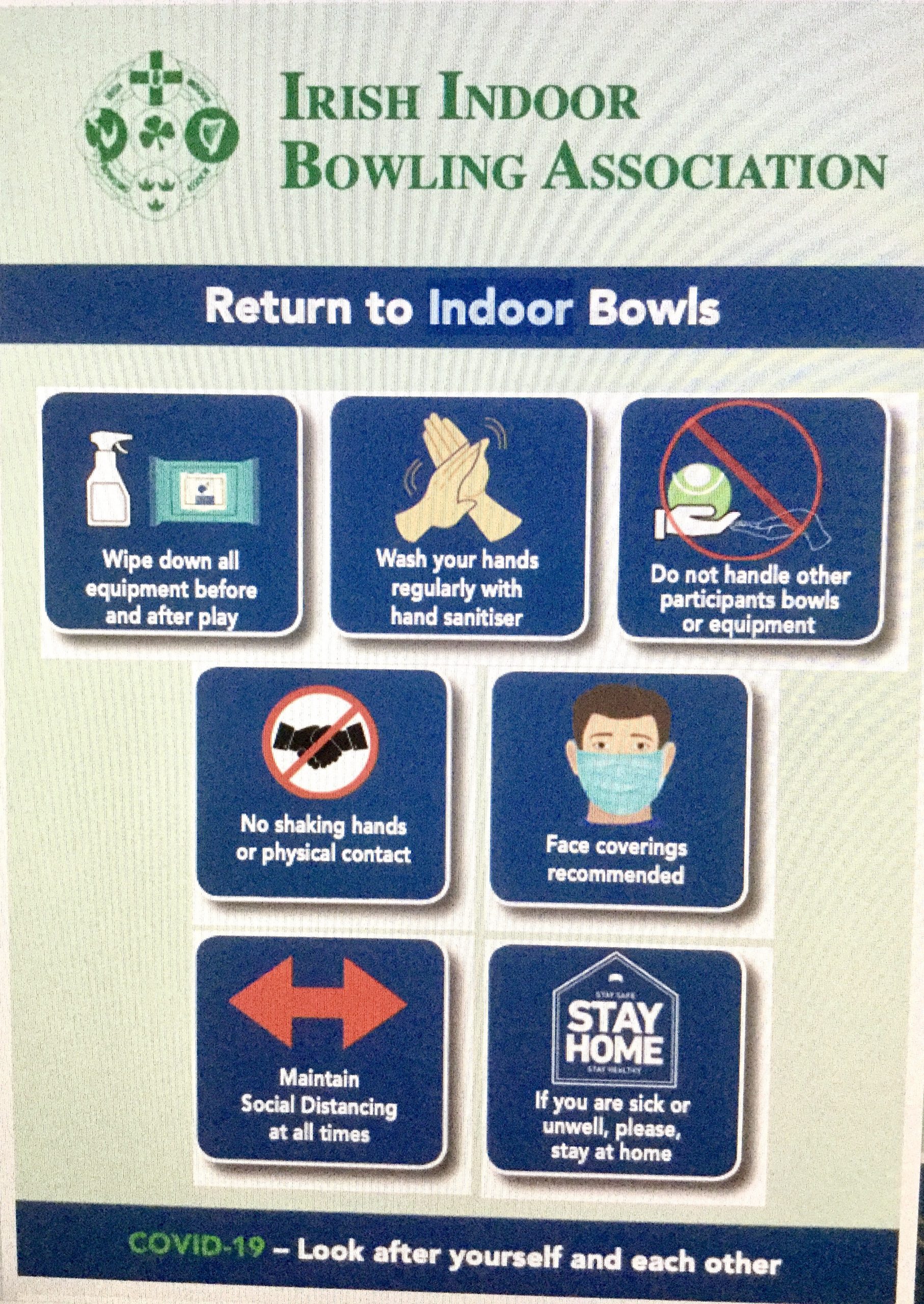
Irish Indoor Bowling Association:
Sport Ireland Return to Safe Play Protocols
Resumption of Bowling under COVID19 Government Procedures
- Club Responsibilities
1.1 Clubs should be fully aware and compliant with Government legislation https://www.gov.ie/en/collection/02cd5c-covid-19-information-resources/ as well as H.S.E. and Sport Ireland/Sport NI directives, and they should ensure that these guidelines are adhered to The Dept of Health have released a mental health document on 17 June 2020 https://www.gov.ie/en/publication/2e46f-sharing-the-vision-a-mental-health-policy-for-everyone/.
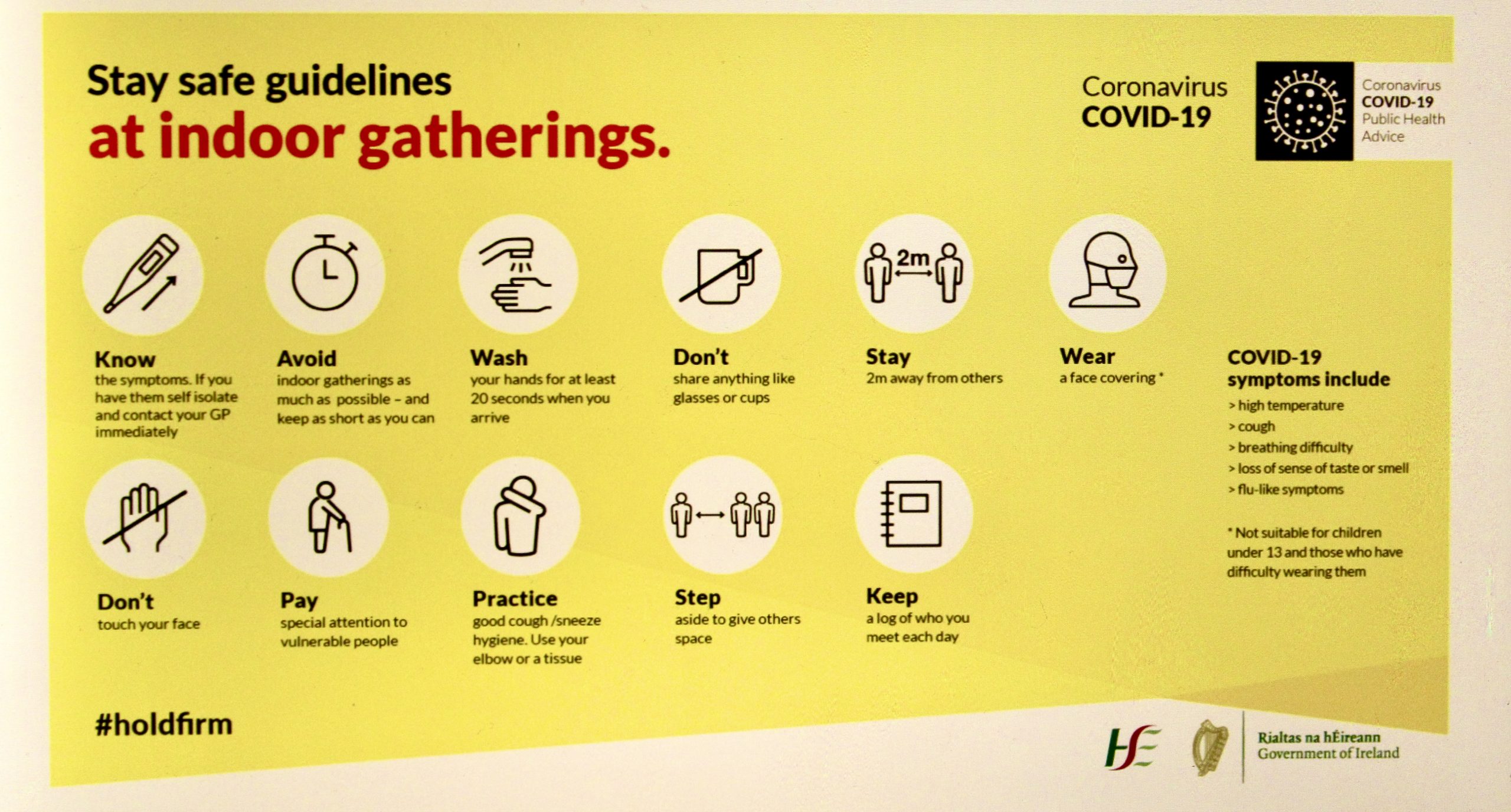
1.2 Two club members will prepare the mats and playing equipment with hygiene in mind and disinfected for safe use by bowlers. This includes sanitising fenders, foot mats, block and jack on each mat. Mats should be laid at least one metre apart. After the game this equipment should be disinfected again before it is returned to storage.
1.3 Sanitisers are to be made available to all bowlers.
1.4 Toilets and hand washing facilities to remain open on club premises with all doors leading to them to remain open where possible. It is the responsibility of each club to ensure toilets are disinfected etc. as required. Tightly bag used tissues and put them rubbish bins provided. These bags should be put in another bag, tied securely and kept separate from other waste.
1.5 Clubs should appoint a designated COVID-19 Officer (see Appendix 1: Roles and Responsibility of a COVID-19 Officer and Appendix 2: Risk Assessment & Guidelines) who should maintain an electronic record of all persons in attendance for all sessions, with contact details. This will help to facilitate contact tracing in the event that a participant becomes ill with COVID-19. Attendance sheets should be completed by all individuals in attendance and stored in an appropriate manner in accordance with General Data Protection Regulation.
1.6 A designated should ensure that the information recorded in advance on the attendance sheet is accurate each session/activity
1.7 An electronic record/attendance sheet should include the below information:
Overall organisation details:
- Club/organisation/facility name
- Activities planned for session
- Location of activity
- Date of activity
Individual details:
- Arrival time
- Departure time
- Full name
- Phone Number
- Email address
- Club/Organisation
- Role/position within organisation (Attendee, parent/guardian, coach etc.)
- Player Responsibilities
2.1 Player Health
2.1.1 All players who have tested positive/in isolation for Covid-19 or are living with a Covid-19 positive person will not be permitted on the premises of a bowling club and will be ineligible to do so until specific criteria are met:
- i) If you have tested positive you may not return to bowling for a minimum of 14 days and at least 5 days without fever or any other symptom, as per government guidelines:
- ii) If you are in self-isolation you may not return to bowling for 14 days or until you have returned a negative test and are symptom free, whichever is less, as per government guidelines: and
iii) If you are living with a Covid-19 positive person, you must also follow (ii), as per government guidelines.
Players who have symptoms should notify their club, if they were due to play, and start self-isolation for 14 days or until a negative test is returned and they are symptom free, whichever is the least amount of time. (See Appendix 3: Health Questionnaire for Club Members and Appendix 4: Club Ready Form).
2.1.2 Ensure attendees enter via designated entry route. Ensure that this route is accessible for all attendees.
2.1.3 Players should put on a suitable face covering, either face mask or face shield, before entering the premises.
2.1.4 All players must sanitise hands upon arrival to a bowling premises.
2.1.5 Pregame and postgame handshakes and other gestures that involve contact with other bowlers are not allowed.
2.2 Attire and Equipment
2.2.1 Club attire for matches to be optional, bowling shoes will remain mandatory. This is the only item that bowlers should change on the premises.
2.2.2 Bowlers are allowed only one bag at the club attended.
2.2.3 Wash or sanitise your hands and sanitise any equipment (including bowls, jacks and mats) you use before and after you play – do not assume that the person before you has sanitised the equipment thoroughly.
2.2.4 Sanitise padlocks, keys and door handles before and after use.
- On the Mat
Recommended numbers
Following the Government’s recent announcement on Covid-19 measures, Sport Ireland engaged with both the Department of Sport and the Department of Health to provide guidance and advice to sporting organisations on the practical implications of the new guidelines. The Guidance has been approved by the Department of Health and is available on the Sport Ireland website. https://www.sportireland.ie/news/sport-ireland-issues-practical-guidance-for-sport-on-covid-19-measures
A key item in relation to indoor sport is as follows: Organised Sports training within indoor facilities can do so in multiple pods of 6 once sufficient space is available and strict public health protocols are in place. The use of multiple pods (i.e. independent groups of 6 not interacting with one another) is assisting with minimising the number of people in a group while acknowledging that some facilities have the capacity to cater for larger numbers of people in a safe manner and within public health guidelines.
Ideally the 6 people will play on the same mat to minimise the chance of transmission. If it is necessary to move mats, then the new mat would have to be sanitised before play could recommence. Also depending on the frequency people are playing, it would be recommended to stay within the same ‘pod’. This is because if someone ends up being sick and has played in multiple different pods on multiple different days then the number of contacts has now increased than if they played within the same pod of 6.
The overall aim of the current restrictions is to limit the chances of transmission and reduce the number of contacts people have in their various social settings.
Please note that the numbers may change at any time in accordance with Government guidance.
3.1 Mat, Jack, Bowls and Scoreboard
3.1.1 Spray chalk to be the only way to mark bowls that have made contact with the jack.
3.1.2 A player will not have control of the mat until the previous player is at least 2 metres from the mat.
3.1.3 In the event of a bowl that has left the rink or gone into the ditch, the bowl is to be removed by one designated player and placed behind the fender using a cloth.
3.1.4 In the event of a no head, the jack is to be replaced by one designated player using a cloth.
3.1.5 Placing of the jack should be done by foot.
3.1.6 When a count has been decided, bowls to be removed either by the owner of the bowls or by removing them by foot.
3.1.7 All bowlers must have a cloth with disinfectant/sanitiser to apply to each bowl and jack before use. Where a person requests assistance with lifting their bowls, the person assisting will wipe their bowl, hand it to the player and return to their seat.
3.1.8 Measuring will be done by one player on each rink predetermined by skips.
3.1.9 One designated player to keep the scoreboard updated.
3.1.10 Scorecards to be updated and kept in the skips’ possession at all times.
3.2 General Social Distancing Guidelines
3.2.1 Each bowler will remain at all times at least two metres from all other bowlers.
3.2.2 Bowlers walking up and down to the head should using space to their left or by using vacant rinks available. Should an adjacent rink be in use and players are walking to and back from the head, you must wait for them to stop before walking to the other end of the rink.
3.2.3 Visits to the head are not permitted, except in singles play where a player may visit the head upon delivery of their 3rd bowl.
- Spectators
4.1 The number of spectators will be restricted to Government guidelines.
To note: Nothing in these protocols obliges any member to play bowls. It is a matter for each person to assess their own risk.
APPENDIX 1
Irish Indoor Bowling Association:
Sport Ireland C-19 Officer (CVO): Roles and responsibilities
- Role of a C-19 Officer
- The role of a CVO is to oversee public health measures across the club.
- This is expected to be a volunteer role.
- A CVO is essential to monitor, advise and support club members to prevent and reduce the spread of Covid-19.
- The CVO must have completed the Sport Ireland Covid-19 training course https://www.sportireland.ie/covid19/course
- The CVO should report directly to the club safety committee (if applicable) and the club chairperson. Clubs should be fully aware and compliant with Government legislation as well as H.S.E. and Sport Ireland/Sport NI directives, and they should ensure that these guidelines are adhered to.
- Selection of a C-19 Officer
- The CVO is identified as a point of contact regarding information relating to all aspects of the Covid-19 controls for the club.
- The CVO should have in-depth knowledge of the IIBAs Return to Play protocols and government guidelines on Covid-19.
- The person should be easily identifiable. All members should be informed of the identity and responsibilities of the CVO.
- The role must be supported by all management and club members
- Responsibilities of a C-19 Officer:
C-19 Officer’s responsibilities and duties fall broadly into 3 categories:
Prior to Return to Play:
- Undertake a Covid-19 risk assessment of club procedures and facilities and develop a Covid-19 safety plan. This can include a facilities audit, review of club procedures and an emergency health and safety plan. A sample risk assessment template can be found here: HI COVID-19 Support Documents
- Ensure both governmental guidelines and IIBA protocols are implemented at all stages.
- Communicate the Covid-19 safety plan and procedures to all members.
Day to day duties:
- Keep up to date with the governmental guidelines and update Covid-19 plans and procedures, as necessary.
- Ensure the plan is being implemented fully and report regularly to the club’s committee. It is advised to develop a daily checklist to ensure all key Covid-19 controls are monitored and maintained within the club.
- Attendance at all club practice sessions to ensure Covid-19 are being implemented in real time.
- Ensure electronic log is kept of members entering and leaving the facility including date and time to assist with contact tracing if needed.
- Ensure contact details of club members are up to date to assist with contract tracing if necessary.
- At all times promote and encourage good hygiene practices to all members.
- Ensure all signage is up to date and visible to all members.
- Ensure regular cleaning of welfare facilities, handrails, door handles, equipment etc. is carried out.
- Ensure hand wash liquid / soap and hand sanitisers are replenished as required.
- Monitor club activities to ensure social distancing is being maintained.
Reactive Emergency Duties:
If someone develops symptoms at a session/practice:
- Ask them to move to a designated isolation area with all their belongings.
- Maintain social distancing at all times – provide with relevant PPE.
- Inform management committee if there is a suspected / confirmed case or if they have been made aware of an individual with COVID-19 symptoms.
- Follow protocol for individuals with COVID-19 symptoms (i.e. send them home, inform them to contact GP immediately).
- Assisting in contact tracing should there be a confirmed case of COVID-19.
- Keeping log of personnel in isolation or restricting their movements
APPENDIX 2
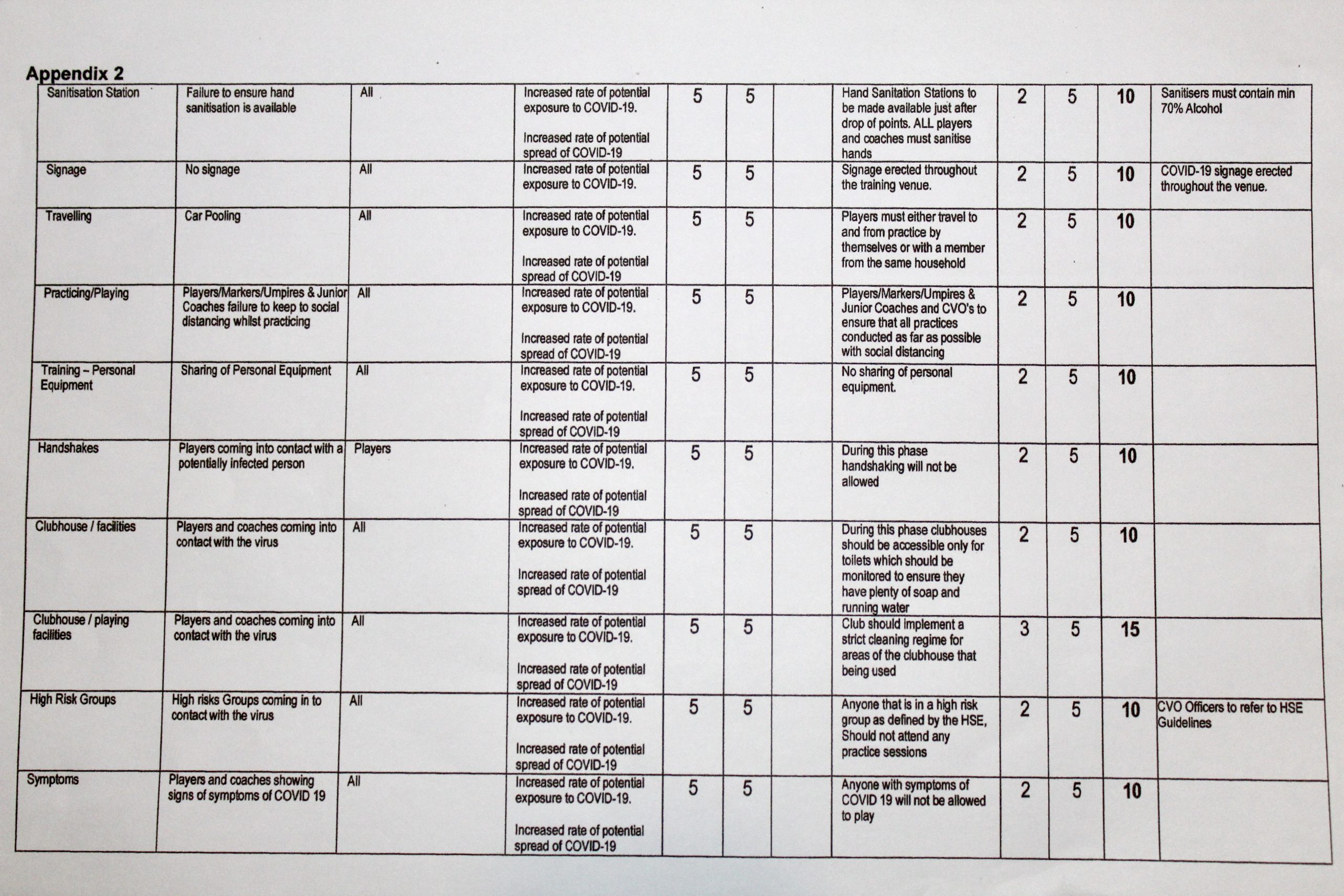
COVID-19 Risk Assessment & Guidance Template
Risk Assessment
Advice and guidance from Government and the Irish Indoor Bowling Association requires all clubs to conduct a risk assessment for COVID-19.
The risk assessment must be carried out by a competent person in order to identify the hazards and quantify the risks of these hazards exposing people to the virus. Hazards and risks cannot be eliminated and therefore must be controlled.
The control measures must be either physical or procedural and must be communicated to those who will work with, or otherwise come into contact with the hazards. In undertaking risk assessments, the following approach should be adopted:
- Gather information and advice from the sporting governing body
- Gather information from Government and other recognised sources
- Consider control measures appropriate to the current Government advice
- Evaluate residual risk to person(s)
The primary risk is the risk associated with the identified hazard assuming that the risk associated, remains completely uncontrolled. The residual risk is the level of the remaining risk produced when proposed control measures have been applied.
The figures given may be interpreted using the risk assessment matrix below.
All club management committees shall ensure that the risk control measures are fully implemented to achieve these levels.
The columns following the residual risk data indicate where additional controls may be required or where special attention should be given. For the avoidance of confusion – the columns of the risk rating sections are headed Likelihood, Severity.
L is for “likelihood” and is given in the first column. S is for “severity” and is indicated in the second column. R is for ‘Risk Rating” and is indicated in the third column. Likelihood x Severity = Risk
The control measures, indicated within the assessment, are reasonably practicable to control the risks identified based on the protocol.
The findings of the risk assessment shall be communicated to those who may be exposed, or otherwisecome into contact with the hazards and risks identified. Club Managements must ensure that the control measures are implemented and managed.
An ongoing review of the assessment will take place and amended if the guidance from the governing body or Government departments is updated and suggests that the last control measures suggested are no longer sufficient to control risks, or are inappropriate, or if additional hazards are identified.
A process of continuous assessment and re-assessment will be undertaken to ensure appropriate risk controls in accordance with all Government and IIBA protocols.
APPENDIX 2
MATRIX


APPENDIX 3
Irish Indoor Bowling Association:
Health Questionnaire Form
For Club Members Returning To Bowls
This document should be returned to the Club Covid-19 Compliance Officer (CVO) prior to bowling. We recommend that this would be completed electronically and emailed (to avoid additional handling) to the CVO no more than two hours prior to the start of training.
Date:
Team/Section:
Name:
- Do you believe you may currently have COVID-19? YES ____ NO ____
- Have you had any of the following symptoms of COVID-19 in the past 14 days?
- High temperature (over 37.5°C) YES _____ NO _____
- Loss of sense of smell and/or taste YES _____ NO _____
- New continuous cough YES _____ NO _____
- New unexplained shortness of breath YES _____ NO _____
If you have answered YES to any of these questions above, you should stay at home and contact your GP by phone for further advice. If you have answered NO to all the above questions, you may play with your team on the date specified above.
Please sign this form to confirm that the details above are true to the best of your knowledge and confirm that you understand the risks involved in participation, are participating on a voluntary basis and that you may opt-out at any time.
Signed:* _____________________________________________________________________
*(For underage players, this document should be signed by a Parent or Guardian)
Please provide your contact details in the event contact tracing is required:
Phone:
Email:
Address:
Please follow all IIBA Return to Play Protocol when travelling to and from the venue and when partaking in practice sessions.
APPENDIX 4
Irish Indoor Bowling Association (IIBA):
Covid-19 Club Ready Form
This document should be returned to your Zone Convener by way of an email from the club secretary prior to your club returning to bowling activities.
Note: A copy of this form will be forwarded to Honorary Secretary for his records.
| Date: |
| Club: |
| Name of Covid – 19 Club officer: | |
| Contact email: | |
| Contact Mobile Phone number: |
Due to impact of Covid19, IIBA in conjunction with Sport Ireland and Sport Northern Ireland, would like to ensure that a return to playing short mat bowls can be done in a safe manner. Government and Sport Ireland guidelines should be strictly adhered to as the safety of all players is paramount.
As the IIBA is an all-island national governing body, governmental guidelines in the Republic of Ireland (ROI) and in Northern Ireland (NI) will be strictly followed. The IIBA is committed to a safe return to sport for all our members at the same time. There may be variations in restrictions (e.g. group size) between ROI and NI, and clubs will be subject to these based on geographic location.
By signing this declaration, we acknowledge we are familiar with the governmental guidelines and the IIBA Return to Play protocol and will comply with the advice contained within these documents.
All clubs need to consider their own situations at any given time. A club’s decision on whether to allow a return to bowling to be based on the situation in their local area at the time.
The IIBA further advises all clubs to ensure that they have appropriate (Public Liability) Insurance in place before any return to bowling activity. It must be noted that insurers may refuse to pay any claim, or may cancel, terminate, or avoid club insurance, if clubs fail to take appropriate steps to implement appropriate health and safety guidelines. We would strongly advise that you contact your insurance company for clarification.
| Signed: | |
| Name: | |
| Date: |
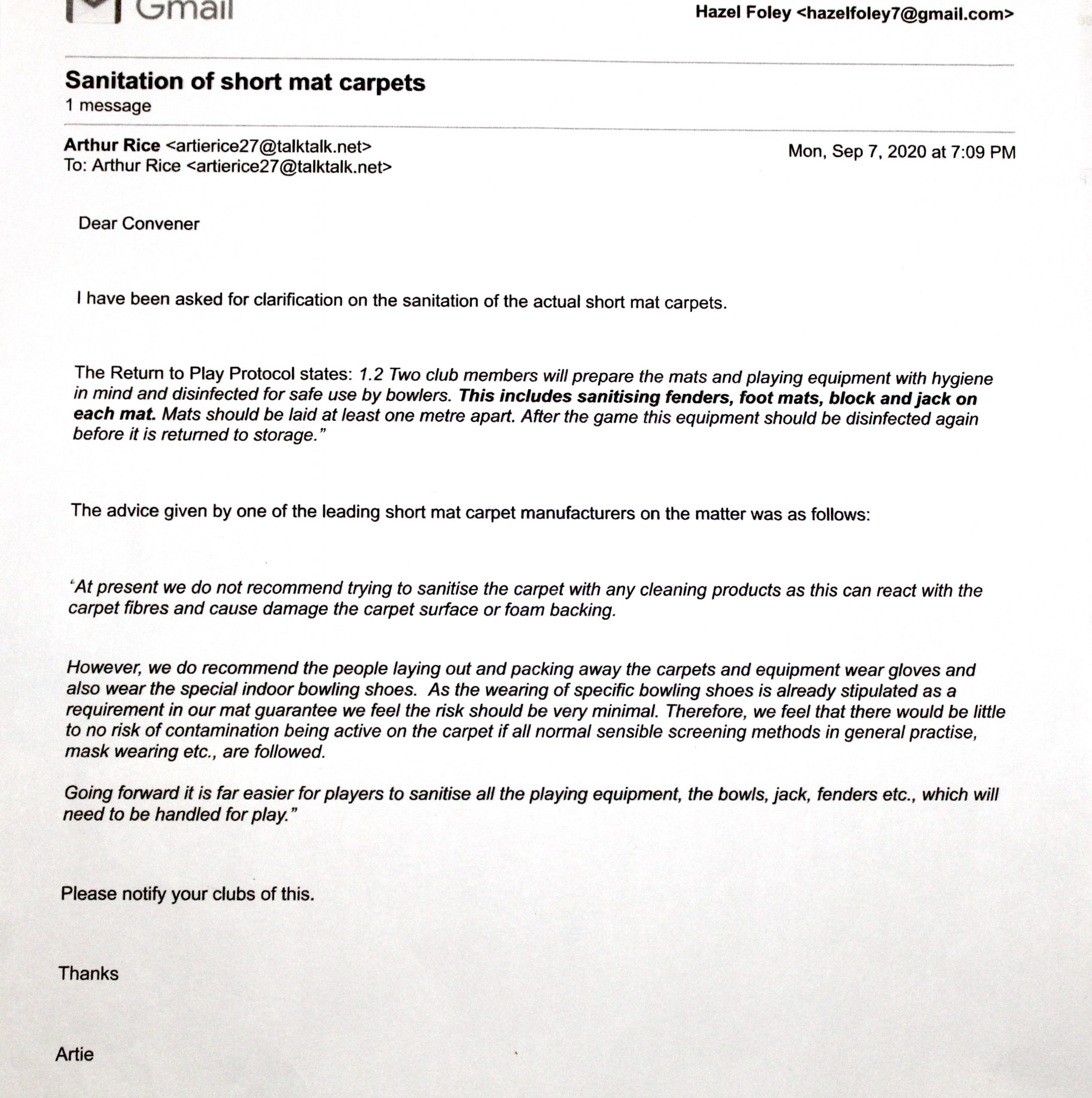
Sanitation of Short Mat Carpets
ADVICE from the HSE
Protect yourself and others from coronavirus
Last updated: 31 August 2020 at 4.55pm
There is no vaccine for coronavirus.
To protect yourself and others from coronavirus (COVID-19), think about how the virus is spread.
Coronavirus is spread in sneeze or cough droplets. To infect you, it has to get from an infected person’s nose or mouth into your eyes, nose or mouth. This can be direct or indirect (on hands, objects, surfaces).
Keep this in mind. It will help you remember all the things you need to do to protect yourself and others from the virus.
Be responsible, be safe
Proper hand washing, respiratory hygiene and social distancing are more important than ever.
We are still at risk of a large surge of infection. Everyone should use their judgement and follow the advice below to help slow the spread of coronavirus.
Try and limit the number of people you meet with outside of your home and the time you spend with them.
You should:
- wear a face coveringon public transport, in shops and other indoor settings – this is the law, you may be fined or refused entry if you don’t wear one
- work from home if possible – if you cannot work from home, keep 2 metres apart from other people
- avoid crowded places as much as possible – leave a location if social distancing becomes difficult
- avoid public transport if possible – walk or cycle instead, if you can
- avoid places where you can’t keep 2 metres apart from other people, where possible
- wear a face covering when visiting people aged 70 or over, or other vulnerable people – be sure to practice social distancing for their safety
- avoid sharing vehicles with people you don’t live with – wear a face covering if you do
You can:
- meet a limited number of people indoors or outdoors for social gatherings, but keep at least 2 metres apart – read more information about having visitors and social gatherings
- attend medical appointments, collect medicine or other health products
- exercise outdoors or indoors in gyms and sports clubs while following public health advice
- visit outdoor spaces, playgrounds and tourism sites, where you can keep at least 2 metres apart from other people
Do not ignore or delay seeking medical treatment for abnormal signs or symptoms that you may be experiencing. Get medical help if you need it.
People at higher risk from coronavirus
People at higher risk from coronavirus should take extra care to protect themselves
Read advice for people over 70 or at very high risk of coronavirus.
Social distancing
Social distancing is important to help slow the spread of coronavirus. It does this by minimising contact between potentially infected individuals and healthy individuals.
You should:
- keep a space of 2 metres (6.5 feet) between you and other people
- avoid communal sleeping areas
- avoid any crowded places
- not shake hands or make close contact with other people, if possible
There is very little risk if you are just passing someone. But try to keep a distance of 2 metres as much as possible.
If you are in a public place where it is difficult to keep 2 metres away from others, you should wear a face covering.
Read more about close contacts and casual contacts.
Social distancing at work
Follow social distancing advice everywhere outside the home. This includes your workplace.
If you are going back to your workplace, read information about returning to work safely.
Contact the Health and Safety Authority (HSA) by emailing wcu@hsa.ie or phoning 1890 289 389 if you are:
- worried about how your workplace is responding to social distancing or other measures
- an employer and want advice on coronavirus prevention measures in the workplace
There is separate advice about:
- self-isolatingif you have symptoms of coronavirus
- taking extra care if you’re at higher riskfrom coronavirus
- cocooningfor people who are at very high risk (extremely vulnerable)
- what to do if you live with someone who has coronavirus symptoms
- what to do if you are a close contact of a confirmed case of coronavirus
- travel and coronavirus– from Gov.ie
Good hygiene and hand washing
Good hygiene and washing your hands properly and often will help to stop the spread of coronavirus. Follow this advice as strictly as possible and encourage others to do this too.
Do
Wash your hands properly and often.
Cover your mouth and nose with a tissue or your sleeve when you cough and sneeze.
Put used tissues into a bin and wash your hands.
Clean and disinfect frequently touched objects and surfaces.
Don’t
Do not touch your eyes, nose or mouth if your hands are not clean.
Do not share objects that touch your mouth – for example, bottles, cups.
When you should wash your hands
You should wash your hands:
- after coughing or sneezing
- before and after eating
- before and after preparing food
- if you were in contact with someone who has a fever or respiratory symptoms (cough, shortness of breath, difficulty breathing)
- before and after being on public transport, if you must use it
- before and after being in a crowd (especially an indoor crowd)
- when you arrive and leave buildings including your home or anyone else’s home
- if you have handled animals or animal waste
- before having a cigarette or vaping
- even if your hands are not visibly dirty
- after toilet use
Keep your hands in good condition. Moisturise them often. Any basic product that is not perfumed or coloured is OK.
Read advice on how to wash your hands properly.
Use the COVID Tracker app
COVID Tracker is a free and easy-to-use mobile phone app that can:
- alert you if you have been in close contact with someone who has tested positive for coronavirus
- advise you on what to do to protect yourself and others
- alert other app users that you were in close contact with, if you test positive for coronavirus
The app is part of our contact tracing operation. Contact tracing is vital to slowing the spread of the virus. The more people that download and use the app, the more it will help contact tracing.
Using the app, along with following the public health advice on this page, can help us all stay safe when we meet up, socialise, work or travel.
You can download the app from Apple’s App Store or the Google Play Store.
Read about why you should use the COVID Tracker app.
Visitors and social gatherings
Apart from the people you live with, limit the number of people you meet and the time you spend with them.
Your risk of getting coronavirus increases as you meet and engage with more people. This is why proper hand washing, respiratory hygiene and social distancing are more important than ever.
Visits to homes
If you have visitors, limit them to a maximum of 6 people from outside the home and from no more than 3 households at any one time. This includes indoor and outdoor spaces. Keep 2 metres apart from people you don’t live with.
Gatherings and events away from the home
Gatherings and events indoors should be a maximum of 6 people from no more than 3 households. This applies to groups in restaurants.
Gatherings and events outdoors should be a maximum of 15 people. Weddings will still be limited to 50 attendees. Even outdoors, you should keep 2 metres apart from people you don’t live with.
Staying safe when you meet people
If you cannot keep 2 metres apart from people you don’t live with, everyone should wear a face covering.
Wear a face covering when visiting people aged 70 or over, or other people at higher risk from coronavirus.
Clean your hands properly and regularly and ask visitors to your home to clean their hands when they arrive. After visitors leave, clean surfaces they have been in contact with. Use your usual household cleaning agents and detergents.
Do not wear disposable gloves instead of washing your hands. The virus gets on them in the same way it gets on your hands. Also, your hands can get contaminated when you take them off.
When not to meet others
You should not meet someone else if you:
- have any symptoms of coronavirus
- have been told by contact tracersthat you are a close contact
Check with people before you meet them to make sure they are symptom-free and feeling well.
Read advice around visiting people aged 70 or over, or other medically vulnerable people.
Compassionate visits
You may be able to visit a very sick relative if they are in a:
- hospital
- nursing home
- hospice
- residential care setting
Read more about visiting nursing homes and residential care facilities.
Read more about hospital service disruptions and visiting restrictions.
Related topics
Shopping safely during the coronavirus pandemic
Travel advice from the Government
Join the Fight Against Coronavirus.
On this page
HSE.ie
Got a question?
We’re here to help.
Callsave: 1850 24 1850
Tweet: @HSELive
Contact details for the Deaf Community
Monday to Friday: 8am – 8pm
Saturday: 10am – 5pm
© 2019 Health Service Executive